Latest news
We are seeking feedback on Australia’s first draft National European Train Control System (ETCS) Mandatory Standard.
The draft standard is being developed as part of the National Rail Standards Framework and will establish nationally consistent technical requirements for ETCS on the National Network for Interoperability (NNI).
Stakeholders are invited to review the Draft National ETCS Mandatory Standard and accompanying Consultation Paper, and make a submission through the ‘Have Your Say’ form below.
Submissions close 7 December 2026.
About the consultation
In 2025, we consulted on the proposed scope of mandatory ETCS requirements. Feedback from that consultation has helped inform the draft standard now being released for public consultation.
The draft standard provides a nationally consistent technical basis for ETCS trackside and onboard systems on the NNI and is based on the European Technical Specifications for Interoperability. Its objective is to support interoperability across jurisdictional and network boundaries while maintaining a pathway for future technological development.
We are seeking feedback on the proposed requirements, including their clarity, practicality and implications for implementation and interoperability.
Read the consultation documents:
You can also find out more at our webinar on 14 October 2026, from 3 pm to 4 pm (AEDT). You can register for the webinar here.
For more technical information or to join one of our technical workshops send us an email.
Workshop dates:
- Monday 26 October 1.30pm-3pm (AEDT) - Rail infrastructure managers
- Wednesday 28 October 1.30pm-3pm (AEDT) - Suppliers and manufacturers
- Thursday 5 November 1.30pm-3pm (AEDT) - Rolling stock operators
To stay up to date with all NRAP news, subscribe to our monthly newsletters here.
Have your say
Draft National ETCS Mandatory Standard
The NTC is seeking feedback on Australia’s first draft National ETCS Mandatory Standard, including its content, application and impacts. Feedback will help inform the final standard before it progresses to Infrastructure and Transport Ministers.
National Rail Standards Framework
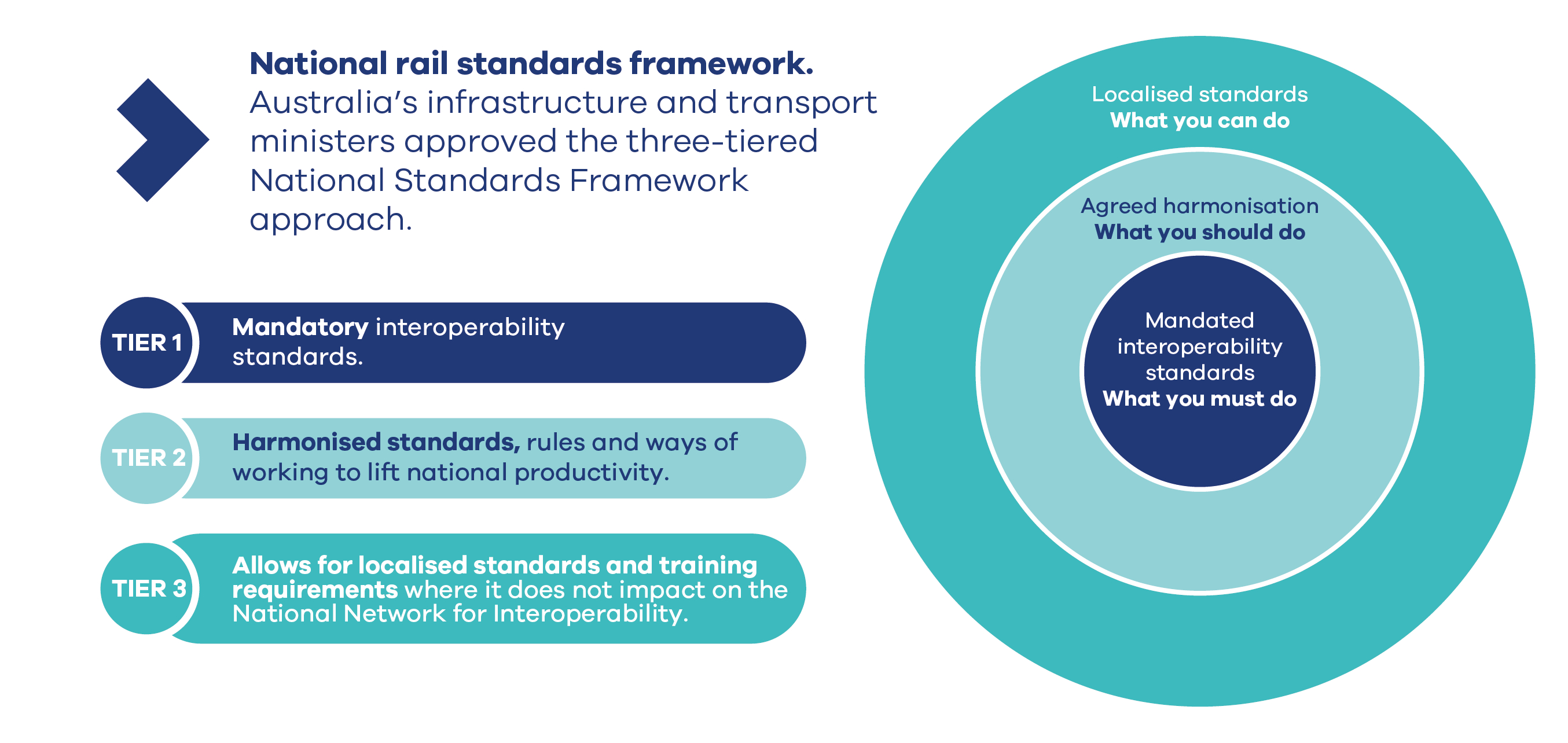
Australia’s infrastructure and transport ministers have agreed to a new three-tier National Rail Standards Framework.
The framework defines:
- Tier 1 - Mandatory standards: what must be done to ensure interoperability and safety across Australia’s rail networks (mandatory standards)
- Tier 2 - Harmonised standards: what should be done to improve consistency (national standards for harmonisation)
- Tier 3 - Local standards: what can be done to lift efficiencies on individual networks (local standards) where national interoperability is not impacted.
Under the changes the NTC will continue to develop a small number of mandatory standards for:
- digital train control technology and driver interface
- rolling stock approval processes
While the Australian Rail Industry Standards Organisation (ARISO) will develop harmonised standards that set out best-practice approaches to align:
- operating rules and processes
- infrastructure and train componentry
- skills and training requirements
Local standards provide flexibility for individual networks where national interoperability is not impacted.
The NTC worked with governments and industry to develop this framework.
Together with the Australasian Railway Association (ARA) and Office of National Rail Industry Coordination (ONRIC), we jointly commissioned the Harmonisation of Rail Standards research report.
The report highlights the need for a national body to oversee the development, implementation and adoption of nationally consistent rail standards.
A more effective governance model
Industry consultation has shown that a stronger governance model is essential to delivering a nationally consistent approach to standards and driving interoperability across Australia’s networks.
The NTC is developing oversight arrangements in five key areas:
- Interoperability assessment – ensuring future network decisions don’t create new barriers to national interoperability
- National standards development and adoption – coordinating how standards are developed, approved and implemented
- Rolling stock approvals – improving the consistency and efficiency of approvals across networks
- Safeworking governance – supporting nationally consistent operating rules and procedures
- Skills and competency oversight – aligning workforce training and accreditation
Changes to Rail Safety National Law
A recent review of Australia’s Rail Safety National Law (RSNL) identified links between safety and interoperability and recommended that interoperability be embedded into the law.
As a first step, an amendment has been made to RSNL regulations, requiring rail transport operators to have systems and procedures that consider interoperability issues. These must be applied when making operational changes on the NNI. An Interoperability Management Plan must then be prepared if interoperability issues are identified.
This marks a shift from the current approach where networks focus on what works best for their own operations.
An Interoperability of Railway Operations Guideline is now available on the Office of the National Rail Safety Regulator (ONRSR) website to help implement the changes.
The NTC is exploring further changes to embed interoperability requirements into the RSNL via a Consultation Regulatory Impact Statement (C-RIS). You can find out more about it and provide feedback here.
How to participate
If you'd like to find out more about how we are helping to support a national approach to rail send us an email or subscribe to our monthly newsletter.
To make a formal submission in response to our discussion papers, you can find out more here.
- Log in to post comments